We build custom Retrieval-Augmented Generation (RAG) systems that connect your documents, databases and
knowledge bases to large language models, giving your team and clients instant, accurate answers based
on your own data.
Every RAG system we build is architected from scratch to fit your use case, data structure and security
requirements.
50+RAG systems deployedAcross legal, healthcare, fintech and
enterprise
98%Answer accuracy rateMeasured on client-defined evaluation
benchmarks
<200msAverage retrieval latencySub-200ms P95 on collections with
10M+ vectors
<2sResponse timeFrom question to answer
*With on-premise deployment. Cloud options send data to the provider you choose.
The RAG pipeline
Three steps, one trusted answer.
Engineered for speed, accuracy and auditability: every answer is traceable to a source.
The pipeline
Your knowledge base, turned into searchable vectors.
We connect to your data sources (PDFs, Word docs, databases, SharePoint, Confluence, S3,
APIs), chunk and embed the content using state-of-the-art embedding models, then store it in a
high-performance vector database: Pinecone, Qdrant, Weaviate or pgvector.
Supports 50+ file formats and live data connectors
Automatic incremental re-indexing when data changes
Metadata filtering for access control and precision
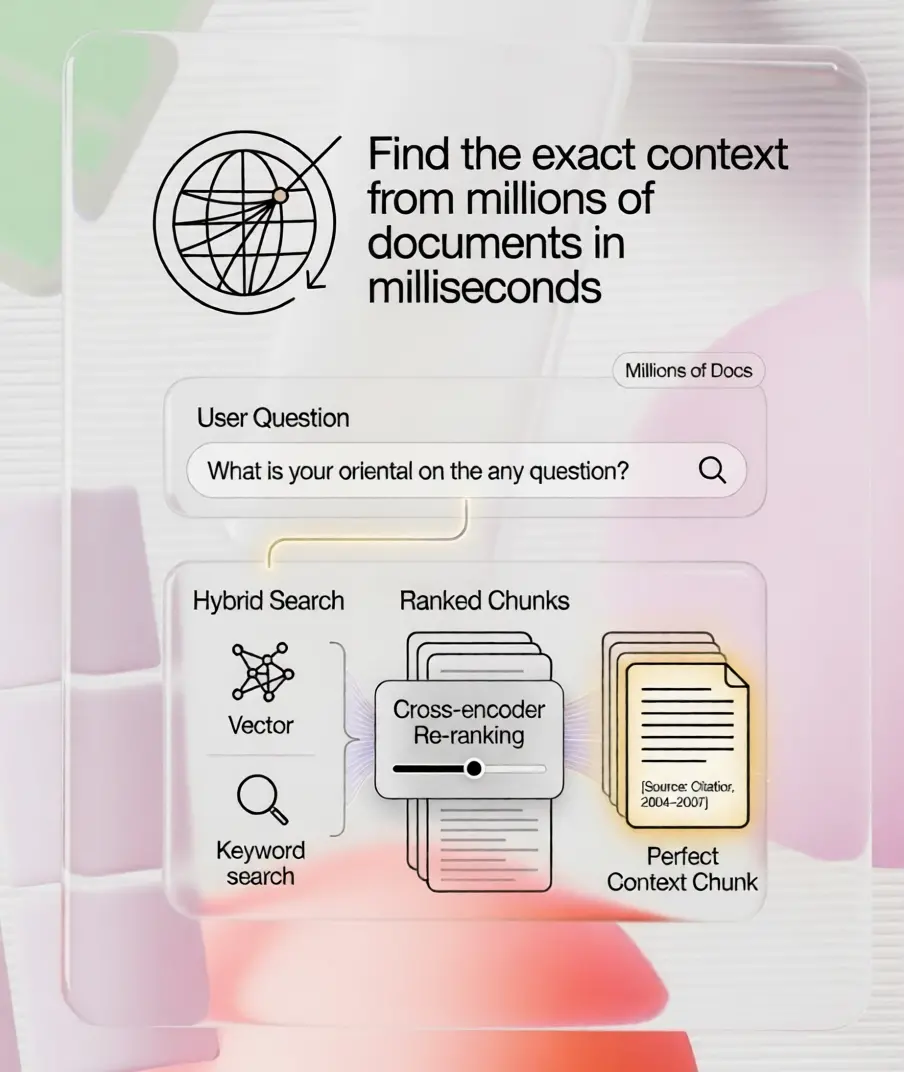
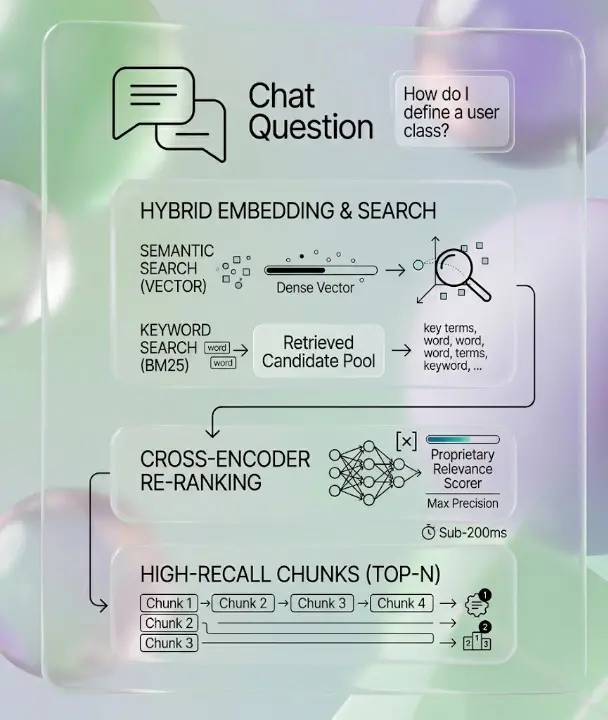
The exact context, found in milliseconds.
When a user asks a question, the retrieval layer converts it to an embedding vector and
runs a semantic similarity search across millions of documents, returning the most relevant chunks,
re-ranked by our proprietary relevance scorer.
Hybrid search (vector + BM25 keyword) for higher recall
Cross-encoder re-ranking for precision
Sub-200ms retrieval on collections with millions of records
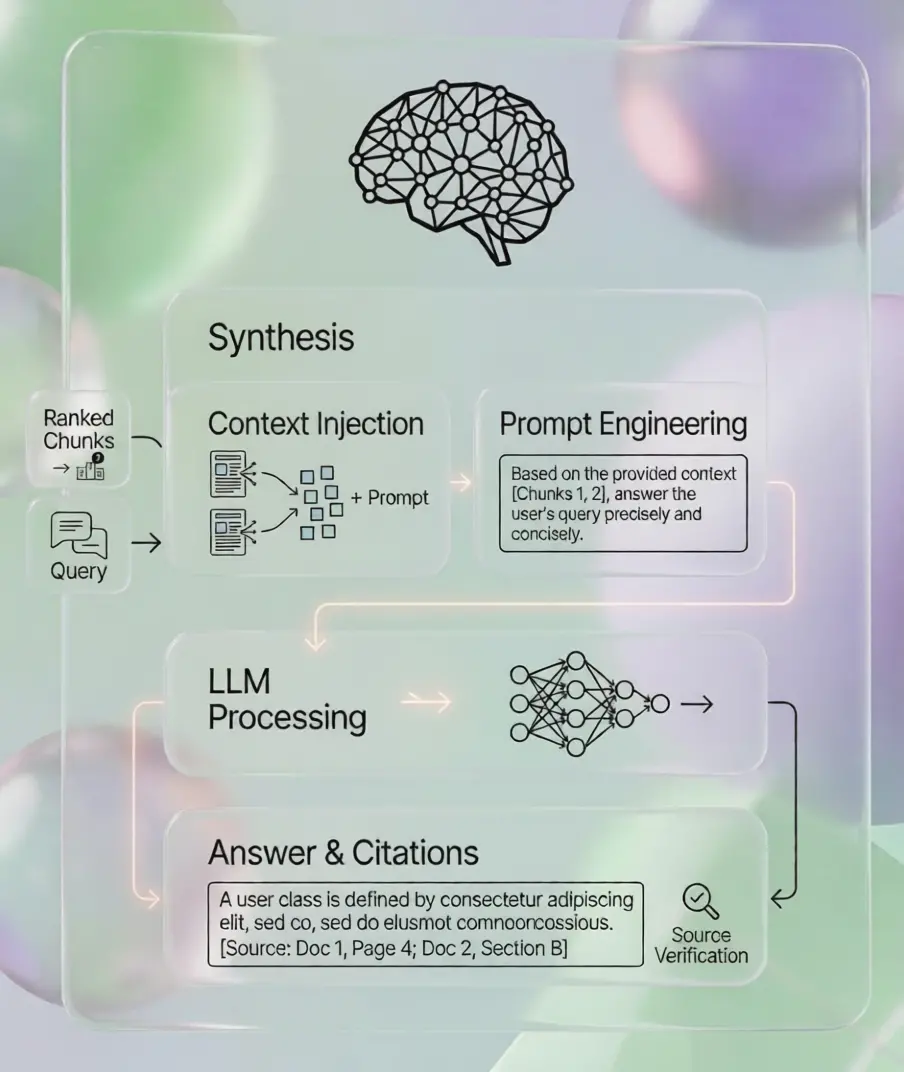
Grounded answers your team can trust.
The retrieved context is injected into a carefully engineered prompt and sent to your
chosen LLM. It writes a precise, readable answer with source citations, so users can check every
claim against the original document.
Automatic inline citations with page and section references
Confidence scoring and fallback messaging
Full audit log for compliance and traceability
What we build
Data-intensive applications.
Multi-source data ingestion
PDFs, Word files, Excel sheets, SQL databases, REST APIs, SharePoint, Notion, Google Drive and more. We
build custom connectors for any source your team relies on.
No code wrappers or pre-built scripts. Every system is engineered for your data schema, sources and
business requirements.
Security-first by design
On-premise options, end-to-end encryption, RBAC at the retrieval layer and full OWASP compliance. Your
data stays on your infrastructure unless you choose cloud.
Reliability & scalability
Distributed vector stores and async re-indexing queues handle any data volume without degrading response
quality.
Ongoing support
Documented APIs, admin dashboards, team training and a dedicated support channel, so your team can own
and evolve the system.
1How is RAG different from fine-tuning an LLM on my data?
Fine-tuning bakes knowledge into the
model weights — it's expensive, slow to update, and can't handle data that changes frequently. RAG keeps your knowledge
base separate and retrieves from it dynamically at query time. This means your AI always answers based on the latest
version of your documents, without retraining. It's also far cheaper and gives you source attribution that fine-tuned
models can't provide.
2Can I run the RAG system fully on-premise with no cloud dependency?
Yes, absolutely. We
specialize in fully air-gapped, on-premise deployments using open-source LLMs (Llama 3, Mistral, Phi-3) running on your
own GPU servers, with self-hosted vector databases (Qdrant, Weaviate) and embedding models. No data ever leaves your
network. This is particularly common for healthcare, legal, and government clients.
3How long does it take to build and deploy a custom RAG system?
A standard RAG system (single
knowledge base, one interface, 1–3 data connectors) typically takes 4–8 weeks from kickoff to production. Complex
multi-tenant enterprise systems with custom retrieval logic, advanced RBAC, and analytics dashboards can take 10–16
weeks. We provide a detailed project timeline during the discovery phase.
4What file formats and data sources does Medians RAG support?
We support 50+ formats: PDF,
DOCX, PPTX, XLSX, CSV, HTML, Markdown, plain text, JSON, XML — plus live connectors to SQL/NoSQL databases, REST APIs,
Google Drive, Dropbox, SharePoint, Confluence, Notion, Jira, and S3-compatible storage. If your data source has an API
or filesystem access, we can index it.
5How do you ensure the AI doesn't hallucinate or make up answers?
RAG dramatically reduces
hallucination by anchoring the model's response to retrieved documents. We add additional safeguards: (1) the prompt
explicitly instructs the model to only answer from provided context, (2) a confidence threshold triggers an (I don't
know) response when no relevant content is found, (3) every answer includes source citations that users can verify, and
(4) our evaluation harness runs automated hallucination detection tests in CI/CD.
6Can the RAG system be customized to fit specific use cases or industries?
Yes. We tailor the
RAG architecture, retrieval strategies, and prompt engineering to your specific use case and industry. For example, a
legal RAG system might use a custom retriever that understands legal citations and a prompt that instructs the model to
answer in a formal tone with precise references. We also offer domain-specific LLMs and embedding models for industries
like healthcare, finance, and customer support.
Put your knowledge to work.
Tell us about your data and we will scope your RAG system.
 medians